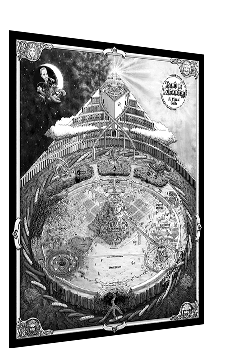
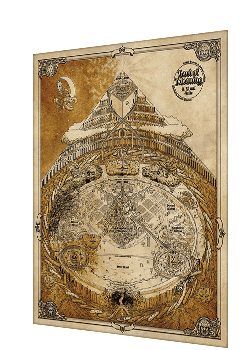
Welcome to the Land of Meaning! Each part of this map represents a different experience, behaviour or way of thinking that commonly appears in myths. Let's go through all the landmarks, shall we? Use the arrow button on the right to advance.
People at the base of this mountain look up and recognize their current limitations. But they also see that the first few steps of the staircase are within their reach and how climbing them would improve their lives.
When people (and lobsters) decide that something is desirable, all the members of society array themselves according to their capacity to achieve that thing. Climbing the mountain is very tough; many are dragged down by the waters and very few can be found on the higher peaks.
After reaching the top, one is tempted to just relax and reap the rewards. But it is important to always pay attention to the ever changing surroundings. Failing to notice changes and adapt is fatal.
The one who arrives at this castle will rule the whole kingdom and therefore will be targeted by those who want to change the balance of power. It is also from here that one can reach beyond the wall and face the Unknown.
This wall represents the traditions and systems built by those who came before. It encircles everything that men know and protects them from the Unknown. When it works properly it gives structure to life while allowing space for its creative aspects to grow.
The land here is becoming too dry for crops to grow and the wall is preventing people from getting what they need the most. Fortunately, no matter how thick the wall is, life always finds a way.
These are layers upon layers of protection that were successively attached to the Culture Wall, to the point where it became too rigid to cradle any life. This colossal structure now oppresses those it was meant to protect.
Some of the people at the top enjoy giving orders to those below and being obeyed all the time. They start believing that they must know what they are doing, and want to make sure it stays that way. So they transition through this walkway to a place that prevents everyone else from raising to their level. Others do the same but without ever going through the top of the mountain.
The purpose of this tower is to exert control over the whole of creation, and it attempts to achieve that by destroying anything that is disobedient or unpredictable, even God himself. Nature, which already had a hard time growing, is actively hunted down and burned. The Culture Wall is not completely destroyed; the useful blocks are taken and added to the tower.
People that arrive here find themselves between a painful climb (with no guarantee of success) to the North, burning evil to the East, drowning evil to the West and oblivion to the South. With options like that, what is the point of going anywhere?
People in the abyss are convinced that the world is a flawed and perverse invention. Some even conclude that the ultimate way of demonstrating this is by doing as much harm as possible before destroying themselves. They think that if they can dig a hole far enough into the darkness, it will prove that light does not exist.
People in this lake look at the idealized top of the Competence Mountain and see no value in their own achievements. If they stay here instead of trying new ways to climb, they might become part of the Resentment Whirlpool.
People here believe that all the misfortune in their life was caused by those in positions of power, so they made the whirlpool to take them down. As the Arrogance Tower crashes everything that is below, the Resentment Whirlpool sinks everything above. The whirlpool destroys the Culture Wall completely and builds a new one.
By sins of omission, culture has crumbled down. Man forgot the meaning of the old traditions so their external shell is all that remains.
Terrible Nature is flooding over the neglected parts of the Culture Wall. There are no human values here, only inclement wilderness. This tragedy was not explicitly man's doing, but maybe a strong wall could have prevented it.
The hero's life finds true meaning when he has one foot in The Known and one in the Unknown. They are exposed to terrible dangers here, but there are also great rewards to be found.
The worst thing you can find in the darkness, inside or outside yourself. People who try to get as far away as possible from a dragon can end up being manipulated by it on the opposite end of the map. The only way to defeat a dragon is face to face confrontation.
Even in the most infertile of lands, a seed of life can still appear.
As the hero goes through the process of fighting the dragons in the Underworld, he can find something natural and pure that couldn't be manifested, and then set it free.
Deep in the belly of the beast the hero might find his Father whose wisdom was unjustly cast out. The hero can revindicate it before it disappears forever.
Even in the deepest wilderness, a trace of humanity can still be found.
The heroes that go through the dragons find out that their tails reach high up into this Heaven. This place is much more harmonious than the one the hero departed from. All manifestations of nature have their corresponding place here, in balance with the magnificent constructions.
From up here one can see beyond all things. This knowledge comes with responsibility, though; those who were being protected by their ignorance will become aware of their own limitations and will be forced leave this place. Others will climb down voluntarily, compelled to share what they've learnt with those that stayed behind.
This place is entered by who have mastered the rules that govern the set of all possible games. Here is where the rules are spoken out and brought to light, not arbitrarily, but to achieve peace using the wisdom of the past.
Tour is over, bucko! Or is it? Note that the crown and eye where we ended bears some resemblance to the top of Competence Mountain?
This means that this whole journey just prepared you for a new adventure into a bigger Unknown.
The elder gods rule the world and make noise.
They behave improperly and upset their progenitors, Tiamat and Apsu, who conspire to devour them.
The elder gods preemptively kill Apsu and inhabit his corpse.
This makes Tiamat furious so she wants to destroy the world.
The elder gods try candidates to fight Tiamat.
Marduk, last born of the gods, comes forth.
He has four eyes and four ears.
He is proclaimed king of the gods.
He fights Tiamat.
Creates the earth and sky.
Osiris is the king of Egypt.
Set kills Osiris to take the throne.
Osiris' body is cut into pieces and spread throughout the world.
Isis searches for Osiris’ body parts.
Isis is impregnated by Osiris' restored body and conceives Horus.
Horus is a falcon with superior eyesight.
He faces Set and loses his left eye in the fight.
Horus rescues Osiris from the underworld.
Horus gains transcendental vision.
Horus and Osiris establish a revivified kingdom.
Adam and Eve live in the Garden of Eden not caring about being nude.
They eat from the Tree of Knowledge, become aware of their vulnerability and get casted away.
They have two sons; Cain and Abel.
Abel’s sacrifices are accepted.
Cain’s sacrifices are rejected and he kills Abel.
Cain’s descendants degenerate and a catastrophe is coming.
Noah, who was righteous and walked with God, is instructed to gather animals and plants to save them from the flood.
The flood kills everyone outside Noah's ark.
Life springs again from Noah’s ark survivors.
Noah’s descendants prosper.
But they become arrogant and start building the Tower of Babel to replace God.
A sear predicts that Prince Siddartha Gautama will either becme a great king or a great spiritual leather. So to prevent Siddartha from developing spiritual concerns, the King makes sure Siddartha grows up surrounded by luxuries and pleasure.
Despite these precautions, Siddhartha experiences the tragedies of life; he sees sickness, aging and death.
The protective illussion under which Siddartha grew up is broken and can't be restored.
Siddhartha leaves the castle and sets out on a quest to find an explanation to mankind's suffering.
His lifestyle of luxury and pleasure offered no tools to deal with his existential troubles.
Siddhartha starts practicing the religious traditions of his culture.
He becomes a master ascetic and puts his body and mind under extreme austerity regimes.
Siddhartha still can't find the answer to his problem, so he deprives himself even further, rejecting all food and water.
As he reaches the brink of starvation, he is offered a bowl of rice. To his followers dismay, he accepts it and eats.
Siddhartha realises that the way towards spiritual liberation is not in extreme self-indulgence or extreme self-mortification, but in the middle.
Siddhartha resolves to sit under the Bodhi tree and not to stop meditating until he had reached enlightenment.
The demon Mara appears and tries to make Siddhartha desist from his quest.
Mara tries to seduce Siddhartha with his daughters. When this fails, Mara threatens to attack Siddhartha with his legions of monsters. But Siddhartha remains immutable.
Mara disappears and Siddhartha breaks free from his material attachments.
Siddhartha becomes Gautama Buddha and has the option to enter Nirvana.
Instead, he chooses to go back to the material world and share his teachings with the rest of humanity.
Jesus is the word that God uses to create the world.
The Holy Spirit concieves Jesus in the womb of Mary, a virgin.
Mary and Joseph travel from to Bethlehem to register in the roman census. Jesus is born and placed in a manger because there is no other place left for them.
King Herod wants to prevent Jesus from becoming the new king, according to the prophecy, so he orders all the male infants in Bethlehem to be killed.
Mary and Joseph save Jesus by escaping to Egypt.
Mary and Joseph learn about Herod's death so they go from Egypt back to Galilee.
John the Baptist preaches in the wilderness about repentance from sins and the upcoming judgement. Jesus is baptised by John and the Holy Spirit descends on him.
The Holy Spirit leads Jesus to the desert. Satan tries to tempt Jesus into renouncing God, but is refused.
Jesus starts traveling, teaching, gathering disciples and performing miracles.
Jesus goes to Jerusalem for Passover and is received triumphantly by crowds of people who believe in him.
The priests, assisted by Judas, get Jesus arrested and ask the Roman governor to condemn him for claiming to be the King of the Jews.
Jesus knows that he is going to be betrayed but does not try to escape the arrest or deny the accusations. He willfully accepts his sacrifice.
The priests persuade the crowds to refuse the Roman governor's offer to release Jesus.
Jesus is betrayed, mocked, forced to wear a crown of thorns and carry his cross. Then he is crucified and dies.
Three days later Jesus appears to his disciples and proves his divine nature.
Jesus ascends to Heaven and is reunited with God.
Pinocchio wants to go to school and to be a normal boy.
Instead, he gets tricked by Cat and Fox and becomes an actor.
Pinocchio becomes Stromboli’s slave.
The Blue Fairy teaches that lies have ramifications and liberates Pinocchio.
Cat and Fox catch Pinocchio on his way home and convince him that he needs to take a vacation.
Pinocchio arrives to Pleasure Island, where all the boys rebel against authority and engage in illicit activities.
Pinocchio realises he is losing his humanity by becoming a donkey, so he escapes the island.
Pinocchio finds Geppetto’s house empty and starts searching for him.
Starving Geppetto finds fish and Pinocchio finds Geppetto.
Geppetto can’t figure out how to escape from Monstro, but Pinocchio takes the initiative.
He uses fire to fight Monstro.
Pinocchio sacrifices himself to save Geppetto.
For proving himself brave, truthful and unselfish, Pinocchio becomes a real boy.
In a faraway land, long ago, lived a King and his fair Queen.
They think they can get away with not inviting Maleficent to Aurora’s christening.
Maleficent retaliates with black magic.
The King orders all the spinning wheels in the kingdom to be burned to protect Aurora.
Aurora grows up in isolation.
Despite all the precautions, she meets Phillip.
Aurora and Phillip fall in love and have intentions of being together.
Maleficent makes Aurora prick her finger and then kidnaps Phillip.
Phillip escapes and fights hordes of minions.
The kingdom gets covered by thorns.
Phillip makes his way to the castle to rescue Aurora.
Maleficent turns into a dragon and fights Phillip.
Phillip kills Maleficent and awakes Aurora.
The kingdom is revivified by a new union.
Simba can't wait to be king.
He wants to prove his bravery by going into the Elephant Graveyard.
Simba is attacked by the hyenas and discovers that he can't take care of himself.
Scar gives a populist speech to get the support of the hungry hyenas.
Scar uses Simba as bait and kills Mufasa with the help of the hyeanas.
Scar blames Simba for Mufasa's death.
Simba runs into the desert and almost lets himself die.
Simba is rescued by Timon and Pumba, and taken to an oasis.
Simba grows up in the oasis escaping the memories from his past.
Nala, Rafiki and the ghost of Mufasa make Simba remember who he is, and so he leaves his hedonistic life in the jungle.
Simba returns to his kingdom and finds it in ruins.
Simba sneaks into Pride Rock to asume his responsibility.
Scar blames his subjects for his failures, would rather have the kingdom destroyed than accepting his errors and still thinks he is better than Mufasa.
Simba faces Scar's accusations and reveals the truth about Mufasa's death.
Scar is defeated and the rightful ruler creates a new harmonious kingdom.
People get rewarded naturally for their competence and that motivates them to improve.
People at the bottom, who can not rise by themselves, should be assisted.
Nature is benevolent and it is being undermined by our systems.
All forms of authority are oppression and we have get rid of them.
If we remove all imposed constraints, everything would be fine.
There are endless interpretations and all equally worthless. It is all just a power struggle.
Being is a perverse creation, it would be better if there was nothing at all.
We have to preserve the systems that have been working so far.
The opposers of authority are ungrateful and destructive. They need to be suppressed by force.
Nature is merciless and our systems might fail to protect us. We must be prepared for a catastrophe.
Evil exists and we will only reach safety after destroying it.
Everything is fine, just follow your bliss.
Land of Meaning: A Visual Guide was created by Fernando Bresciano and inspired by Jordan B. Peterson's lectures about mythological archetypes. Why? [Read more]
This interactive guide is a work in progress, if you want to be notified when new features are added, you can join the newsletter, follow me on Twitter or on Instagram.
Map displayed with Leaflet.
Interface implemented with Materialize.
Black Castle font by Richard William Mueller.
Prints are now available!
Please note: If you want the smallest texts to be readable, choose a print size that is taller than 19″ or 480mm.
Tap this arrow to go to the next stop.